 GOBLIXO
Same address. new rules?
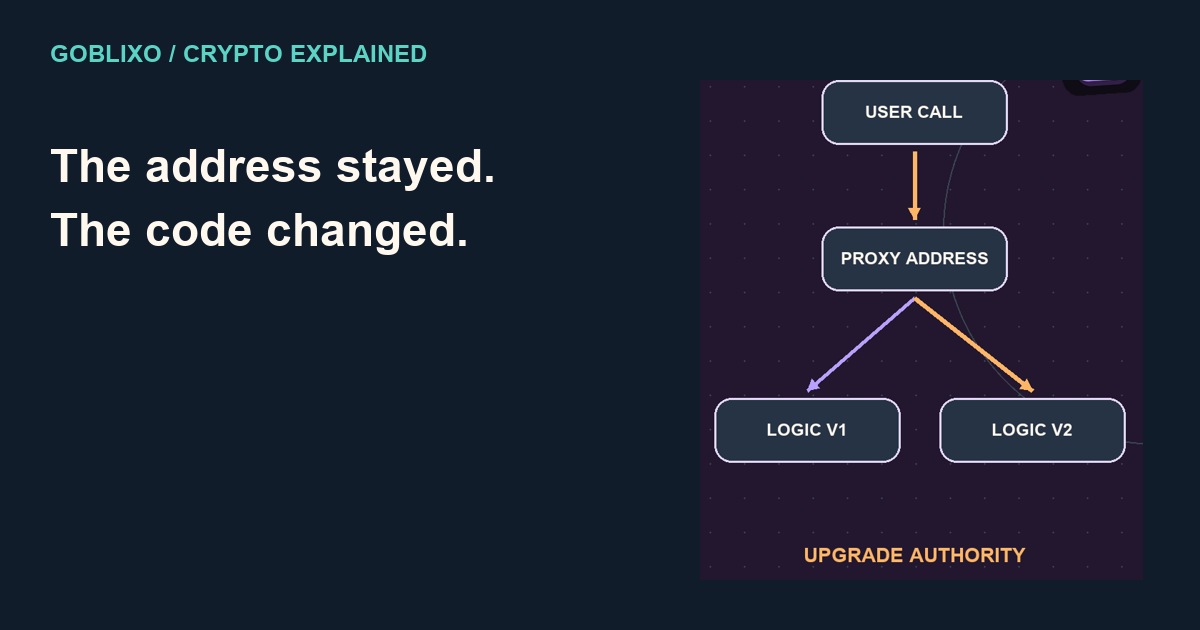
You bookmarked a smart contract address. Months later its behavior changes, while the address stays the same. How? Some contracts use a proxy that delegates work to an implementation contract.
Meet the proxy
Think of a reception desk with a fixed address. The desk forwards requests to a rulebook elsewhere. This analogy explains routing; it is not a full model of execution.
Logic lives elsewhere
In common proxy designs, storage stays with the proxy while delegated code comes from the implementation. A configured upgrade mechanism can change which implementation handles future calls.
An upgrade switch
So an old address and a previous audit do not establish that the current logic is unchanged. You need to know the implementation and configuration active at the time you interact.
Who holds the power?
Ask who can authorize an upgrade. A single administrator, a multisignature account, governance or a timelock can create very different control arrangements. Some designs have no upgrade path at all.
Read the live setup
Read the specific project documentation and verified contract structure. Identify upgrade authority and delay rather than treating the word decentralized as an answer. A verified source code badge is not a security guarantee.
A careful way to use this explanation
Proxy architectures differ. Transparent and UUPS patterns place upgrade controls in different locations, and extra modules can alter the effective authority. This article is a conceptual map rather than a contract audit or an assessment of a named protocol. An administrator label alone does not prove whether the address is a person, a multisignature setup or another contract. Review current state alongside documentation.