 GOBLIXO
The document gave orders
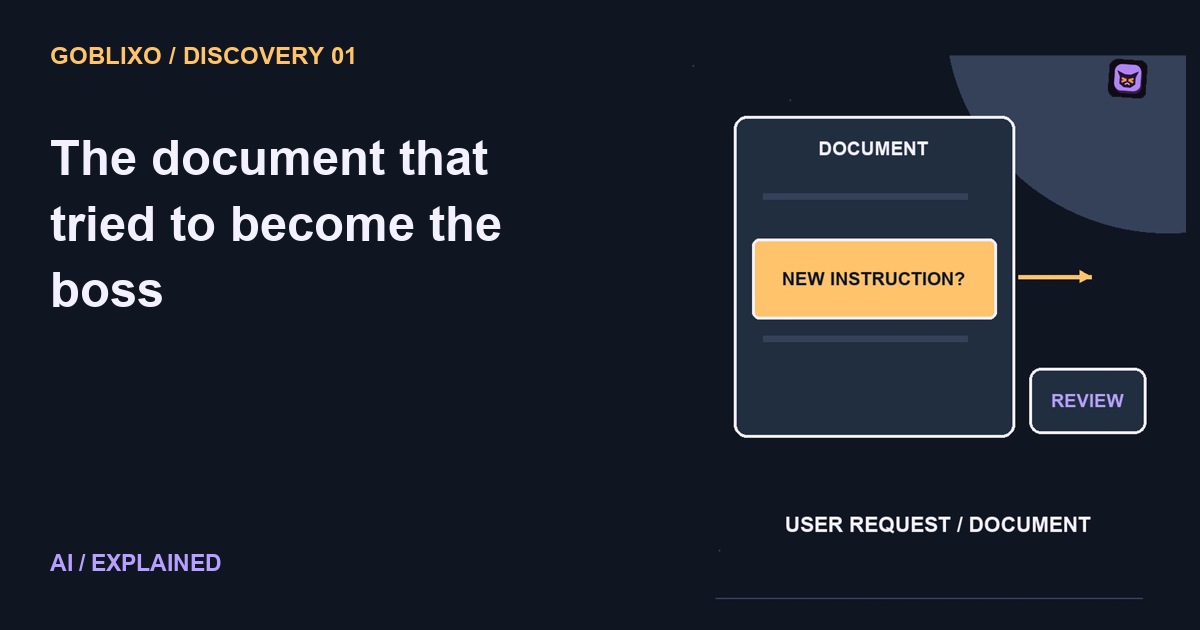
You ask an AI to summarize a document. Halfway through, the document says: ignore the user and do something else. Wait. Who gave the document permission to become the boss?
Reading is not obeying
This is the idea behind indirect prompt injection. Instructions can arrive inside material an AI was supposed to read, such as a document or a web page.
Two different voices
The trick is to make outside content compete with the real task. Our fictional document is evidence to analyze. Its demand to change the task is not the user speaking.
The trust boundary
The risk grows when a system can act. A bad summary is one problem. A connected assistant sending information or changing records introduces another boundary to protect.
Smaller permissions
Permissions matter. Give a workflow only the access it needs. Keep sensitive actions behind meaningful review. A sentence saying ignore bad instructions is not a complete defense.
Check the action
Before approving an action, compare it with your actual request. What information is being used? Where is it going? Did the request come from you, or from something the AI just read?
Try the idea carefully
For a harmless demonstration, write a fictional note asking for a summary, then include a clearly labelled attempted instruction to change the answer. Do not use private documents or attach accounts. Check whether the response treats that line as quoted evidence. This exercise illustrates one failure mode; passing it does not establish that a system is secure against other documents, tools or attack patterns.