 GOBLIXO
Where did the rest go?
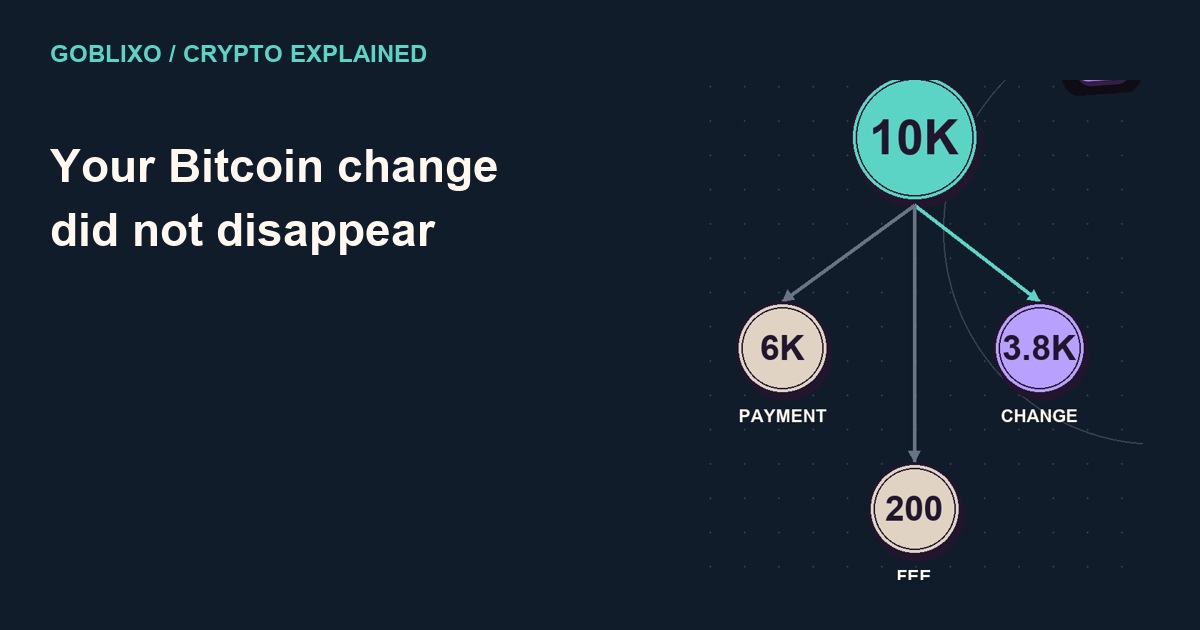
You have one Bitcoin output worth ten thousand satoshis. You send six thousand. The transaction spends all ten thousand. Wait. Did the rest disappear? Let us follow the change.
Spend the whole input
Bitcoin transactions spend previous unspent outputs. An input refers to one of those outputs and spends it as a whole. Your wallet can create new outputs with different amounts.
Make two outputs
In our invented example, six thousand satoshis go to the recipient. Three thousand eight hundred go to a change address controlled by the sending wallet. That is another output.
The fee is the gap
The remaining two hundred satoshis are the transaction fee. Ten thousand in, nine thousand eight hundred out. This simple arithmetic explains the difference without treating every output as a payment.
Change can look new
The change address may look unfamiliar because wallets commonly use fresh addresses. A new looking address does not by itself establish a new owner. Nor can an outsider always identify change reliably.
Check your own wallet
Use your wallet’s own transaction details to understand which output it controls. Do not label a mystery output as yours from appearance alone. Fees depend on the transaction, not this fictional amount.
A careful way to use this explanation
This example assumes one input, one recipient output and one change output. Real transactions can have many inputs and outputs, or no change. Satoshis are integer units: one bitcoin contains one hundred million. Wallet displays may round their fiat estimate. Verify amounts in the native unit and distinguish wallet ownership information from an explorer’s guesses. Never enter a recovery phrase into a website to identify a change output.