 GOBLIXO
Three keys. two approvals.
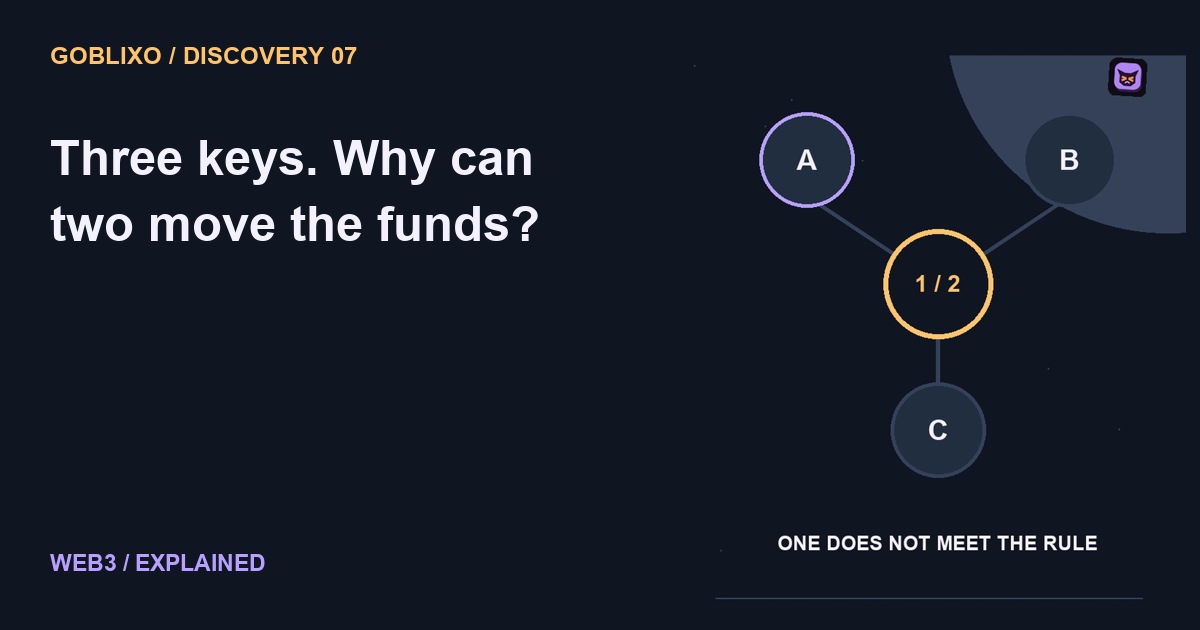
A wallet has three signers, but a transaction needs only two approvals. Does every signer own a separate third of the balance? No. The interesting part is the approval rule.
The threshold rule
In a simple two of three multisignature setup, three designated signers exist and the threshold is two. Think of three authorized people and a rule that any two must approve the same action.
One approval is not enough
One signer alone does not meet that threshold. A single approval is not a smaller transfer waiting to combine with another transfer. It is one approval toward the account's execution requirement.
Two matching approvals
When two valid signers approve the required transaction, the threshold can be satisfied. The account still follows its actual contract rules. Our diagram shows the basic idea, not every implementation.
One key goes missing
If one signer loses access, the other two may still meet a two of three threshold. If two become unavailable, that same basic setup cannot meet it. Backups and signer independence matter.
The setup still matters
Multisignature is not automatically safe because the number is bigger. Contract configuration, additional modules, signer security, and the ability to recover need careful review. Do not copy a diagram into a live treasury.
Try the idea carefully
The possible pairs are A plus B, A plus C, and B plus C. This is a combinatorial illustration, not a claim about every wallet branded multisig. Smart-account modules or alternative authorization paths can change the effective security model. Review the deployed account and recovery arrangements with appropriately qualified help before putting assets at risk. This page does not ask you to connect a wallet or sign anything.