 GOBLIXO
Two ways out
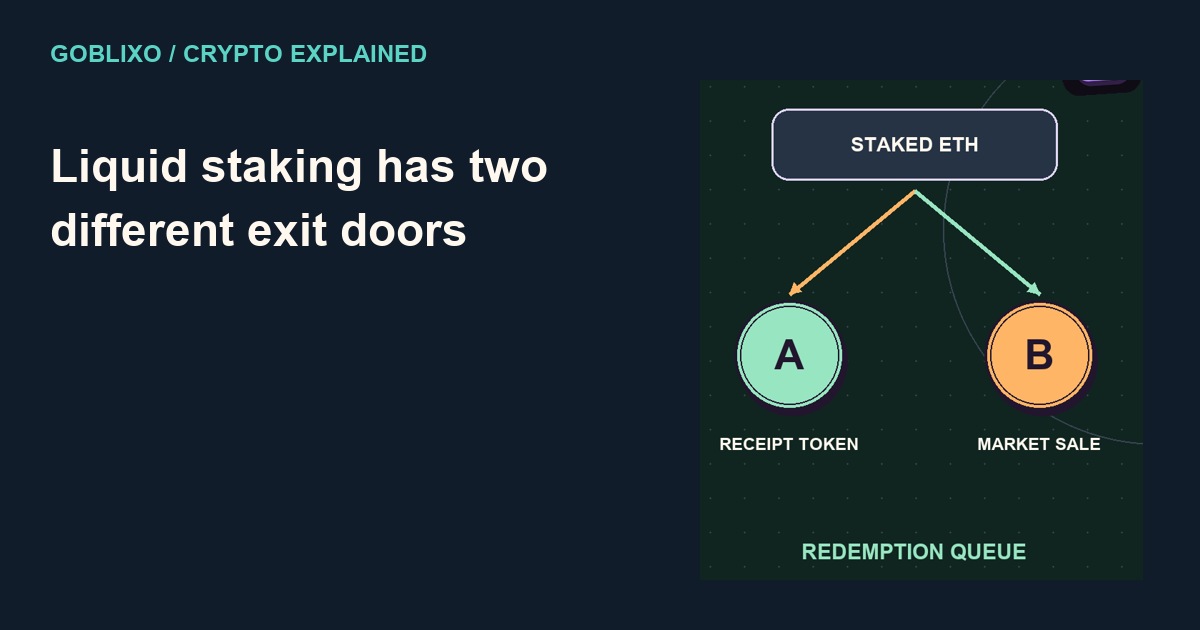
A liquid staking token represents a claim linked to staked assets. So why might selling it give a different result from redeeming it? Because those are two different exit routes.
A claim on a service
The Ethereum protocol rewards validators. A liquid staking service can issue a token representing a claim through its own contracts and rules. That token adds dependencies beyond holding ordinary ether.
Sell on a market
One route is a secondary market sale. The amount received depends on the available buyers, liquidity, fees and execution conditions at that moment. The market does not promise the redemption value.
Request redemption
The other route is the protocol’s redemption process. Its rules can include queues, waiting periods and different settlement mechanics. An instant sell button does not remove those underlying constraints.
The prices can differ
If many holders want a quick exit, a market price can diverge from the claim’s underlying value. A displayed exchange rate is therefore not a promise about an executable sale.
Count the dependencies
Also check operator, contract, governance and penalty risks. Liquid does not mean risk free or instantly redeemable in every situation. Do not compare an advertised rate without asking how the exit works.
A careful way to use this explanation
Different services use different token accounting and redemption designs. A rebasing token and a token with a changing exchange rate need different interpretation. The diagram is not a comparison of current providers or an invitation to deposit. Read the applicable documentation for fees, eligibility, queue behavior and loss allocation. No return or immediate exit is guaranteed.