 GOBLIXO
Same website. different answers.
You move a website to a new address. Your phone sees the change, but a friend still reaches the old place. Did the internet split into two versions? Sometimes, you are seeing cached answers.
The name needs an address
DNS helps translate a domain name into information used to find its service. A browser does not discover the intended server just by recognizing the words in a website name.
A saved answer
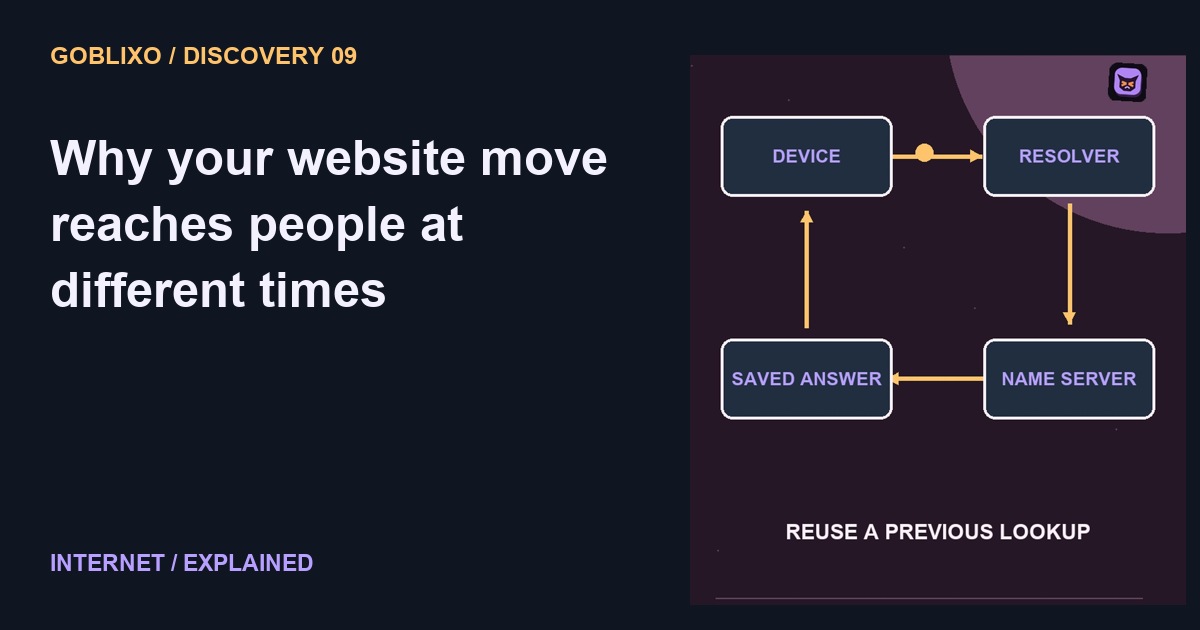
To avoid repeating every lookup from scratch, answers can be cached at different places. A resolver or a device may already have an answer from an earlier lookup.
The expiry timer
A DNS record's time to live tells caches how long an answer may be reused. Changing the authoritative record does not instantly replace every answer that was already saved elsewhere.
Not one global switch
So a website move is not one giant switch for everyone at once. Different cached answers can expire at different times. Other network or configuration problems can produce similar symptoms too.
Separate the layers
And DNS cache is not the same as a cached web page. Finding a server, fetching a page, and displaying previously stored content are different stages. Diagnose the stage instead of refreshing without a question.
Try the idea carefully
For a harmless mental model, imagine two address books that copied an old entry at different times. Updating the original does not rewrite the copies immediately. The analogy is limited: real DNS has multiple record types, negative caching and different resolver behavior. A TTL is a cache instruction rather than a guarantee about exactly when every visitor will see a deployment. Check authoritative configuration separately from a browser's page cache.