 GOBLIXO
One person. one vote?
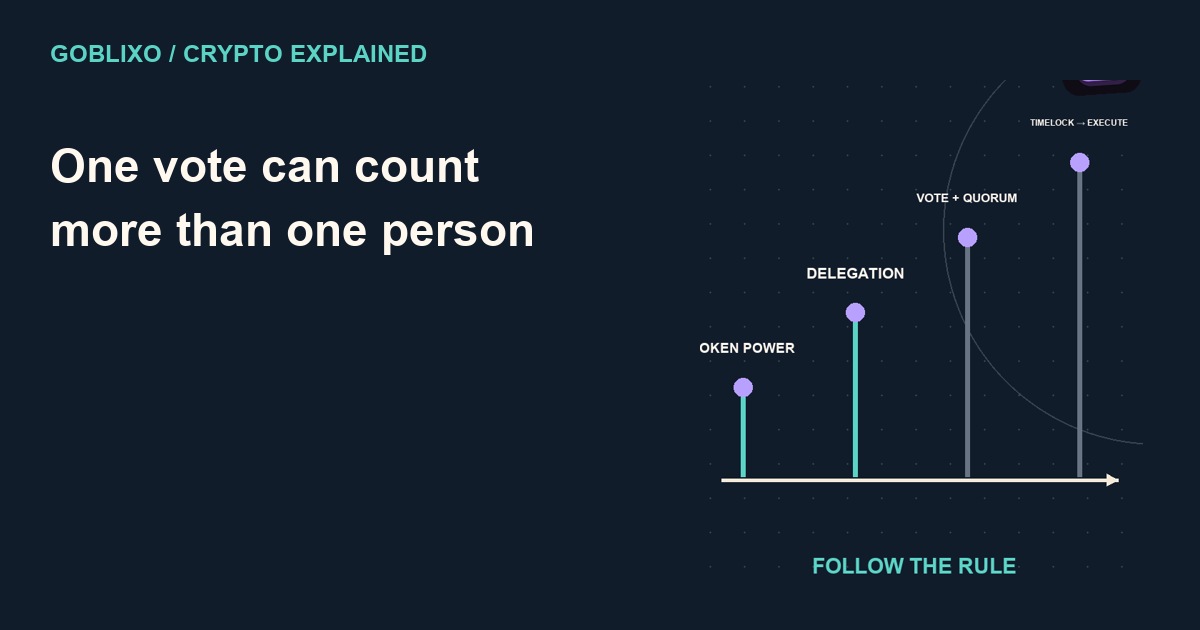
A crypto proposal receives a thousand votes. Does that mean a thousand people agreed? Not necessarily. In many token governance systems, the unit being counted is voting power, not individual humans.
Count voting power
Token weighted voting can assign influence according to an eligible token balance or another defined mechanism. One address can control more voting power than many smaller addresses combined.
Delegate the vote
Delegation can let one participant exercise voting power assigned by others. The number of delegates casting ballots therefore does not directly tell you how many holders are represented.
Quorum is a threshold
Quorum sets a participation threshold. A proposal may need both sufficient participation and a passing result. The precise formula, snapshot and which votes count toward quorum depend on the system.
Passing is not execution
A successful vote may also face a timelock before execution. Other systems use off chain signaling followed by a separate action. A poll result alone does not prove a contract changed.
Who can change the rule?
Read proposal eligibility, voting weights, delegation, quorum and execution authority together. Ask who can upgrade these rules. The word community is not a complete description of control.
A careful way to use this explanation
Systems may use different voting assets, quadratic methods, identity mechanisms or off chain tools. Our example describes a common token weighted pattern and must not be generalized to all DAOs. The block used for a voting snapshot can affect eligible power. A timelock can provide notice but is not a guarantee of safe governance. Check the deployed mechanism and current authority rather than relying on the proposal title.