 GOBLIXO
One million or one?
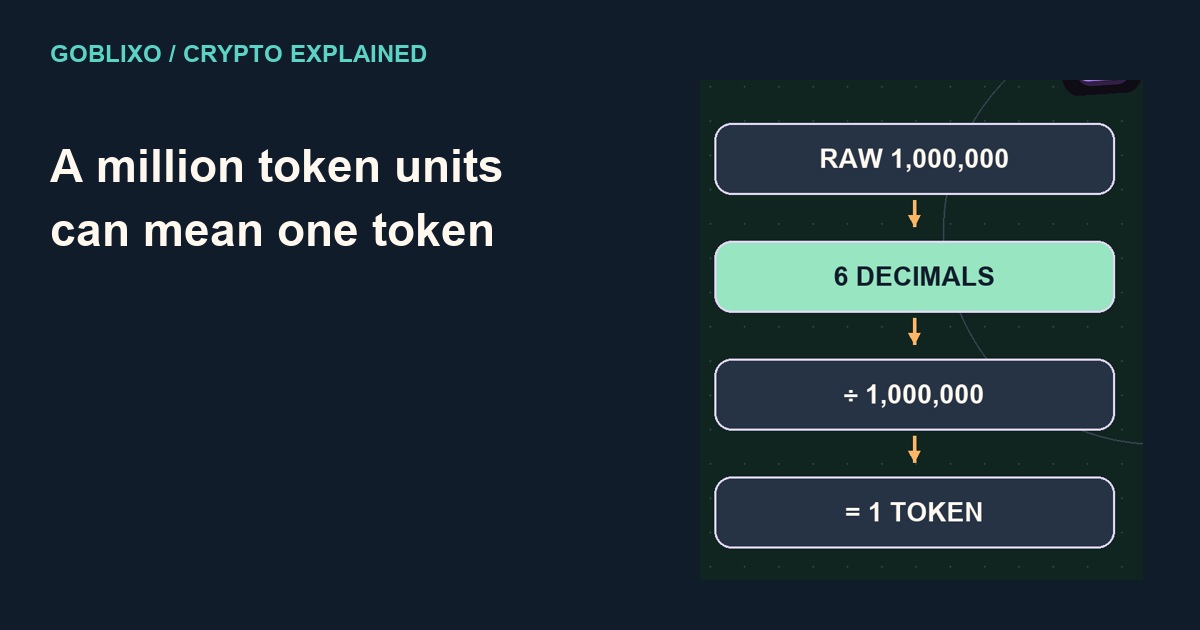
An explorer shows one million raw units, but your wallet shows one token. Which screen is wrong? Possibly neither. The missing detail is how the token’s smallest units become a human readable amount.
The contract uses integers
Many token contracts store balances as integers. The display needs to know how many decimal places to apply. That conversion is a presentation rule, not a sudden change in your balance.
Decimals set the display
For a token using six decimals, one million raw units divided by one million displays as one token. We are using an invented token and a deliberately simple number.
Same raw number
Give another token eighteen decimals, and that same raw integer represents a much smaller displayed quantity. Comparing raw numbers from different contracts can therefore be misleading.
Price is a different input
Decimals do not establish market value. A token’s price, identity and actual liquidity are separate questions. A large number of tiny units does not by itself make someone rich.
Check the token contract
Check the documented token contract on the correct network, and the unit shown in each field. ERC twenty makes the decimals method optional, so interfaces also need to handle incomplete metadata.
A careful way to use this explanation
For a nonnegative integer raw balance R and decimal count d, the usual display is R divided by ten to the power d. This changes formatting, not the underlying ownership record. Do not use floating point arithmetic to build a real financial system from this example; large token integers can exceed ordinary JavaScript number precision. The decimal field can be missing or misrepresented by an interface. This exercise does not verify a live token or its price.