
GOBLIXO✳Field guides ↗
← THE GOBLIXO BLOG / Crypto explained

You can own more tokens and still trail holding

You add two tokens to a liquidity pool. Later, your position has more of one token, yet is worth less than simply holding the original pair. How can both be true?

BY GOBLIXO EDITORIAL · 2 MIN READ
PUBLISHED 2026-11-11 · SOURCES CHECKED 2026-11-11
GOBLIXO original explanatory diagram: You can own more tokens and still trail holding
FICTIONAL CONSTANT PRODUCT POOL / NO FEES

Compare the pool with holding.

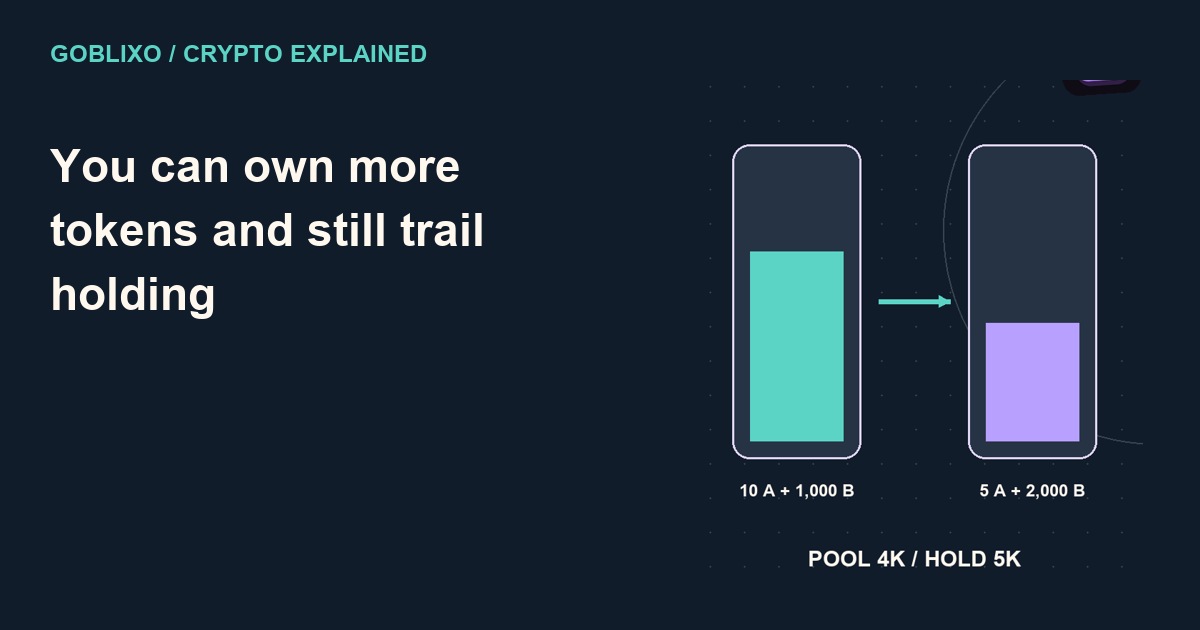
Start with 10 A and 1,000 B. Initially, 1 A is worth 100 B. Move the final relative price to see how the pool mix changes.

At 400 B per A: pool has 5 A + 2,000 B. Pool value 4,000 B; holding value 5,000 B; difference −20% versus holding.

Assumes arbitrage, x×y=10,000 and no fees. Excludes incentives, execution costs and concentrated ranges. Educational arithmetic, not a forecast.

THE USEFUL PART

Trading fees may offset some difference, but they are a separate component. Concentrated liquidity changes the behavior further, especially near or outside a selected range. Our simple pool is not every pool.

More tokens. less value?

You add two tokens to a liquidity pool. Later, your position has more of one token, yet is worth less than simply holding the original pair. How can both be true?

Start with a simple pool

Use an invented constant product pool. It starts with ten units of token A and one thousand of token B. Ignoring fees, their balance product is ten thousand.

The outside price moves

If A’s outside price rises, arbitrage trades can change the pool’s composition. The pool ends up with less of the appreciating token and more of the other token.

The pool mix changes

Your share follows that changing mix. Counting only the number of units of one token misses the other side. The comparison needs both assets valued at the same final prices.

Compare with holding

The difference against holding the initial assets is commonly called impermanent loss. The name does not promise that it will reverse. Withdrawing can lock in the current result.

Fees are a separate line

Trading fees may offset some difference, but they are a separate component. Concentrated liquidity changes the behavior further, especially near or outside a selected range. Our simple pool is not every pool.

A careful way to use this explanation

For a fee-free illustration, suppose the outside price of A moves from 100 B to 400 B. A balanced pool satisfying x*y=10,000 then has x=5 and y=2,000. Its value is 4,000 B, while holding the original 10 A and 1,000 B gives 5,000 B. The illustrative difference is 20% of the holding baseline. This ignores fees, price impact, incentives and other costs; it is not a forecast.
Continue your research

Sources & editorial notes

Based on official documentation, checked 2026-11-11. Examples are illustrative. This is research, not hands-on testing; provider terms and availability can change.

  1. Uniswap: Impermanent loss ↗
  2. Uniswap: How automated pools work ↗
  3. Uniswap: Concentrated liquidity ↗

Questions about a product? Use the provider’s official support. Never share recovery phrases or private keys.

Keep asking better questions.

ALL STORIES ↗