 GOBLIXO
No gas. no risk?
A wallet asks you to sign a message. No network fee appears. Does that make it harmless? No. Some signatures can authorize token permissions that another person later submits on chain.
A signed permission
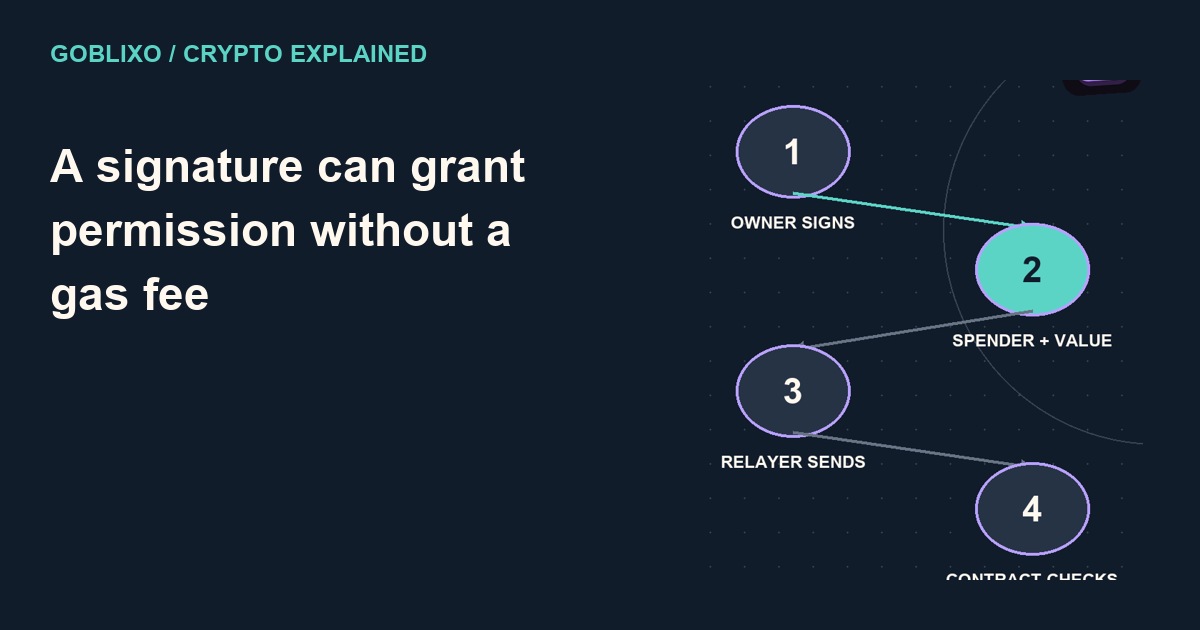
ERC twenty six twelve defines a permit extension for compatible tokens. An owner signs structured data to authorize a spender allowance, instead of personally sending the ordinary approval transaction.
Someone else submits it
A relayer can submit that signature. Someone still pays for execution, even if the signer did not pay gas at signing time. The permission becomes effective when the contract accepts the permit.
Read the spender
The important question is what the signature authorizes. Inspect the token, network, verifying contract, spender and amount. A free looking button is not an explanation of those fields.
Check value and deadline
The standard also uses a nonce and deadline. These help constrain acceptance and reuse, but they do not make a malicious spender trustworthy. A large allowance remains a large allowance.
Schemes differ
Not every signature uses this standard. Permit two, login messages and other schemes have different rules. If the wallet cannot make the requested authority understandable, pause instead of assuming gasless means safe.
A careful way to use this explanation
A deadline limits how late a signed permit may be submitted; it does not necessarily impose the same expiry on the resulting ERC-20 allowance. The details of the token implementation matter. This is not a demonstration using a real wallet. Do not sign an example supplied in a comment or direct message. ERC-2612 and Permit2 are different mechanisms, so a checklist must first identify which one is actually requested.