 GOBLIXO
Why wrap ether?
An Ethereum app asks for wrapped ether instead of ordinary ether. Did it send your coins to another blockchain? Not necessarily. Wrapping and bridging are different operations. Let us separate them.
Native eth has its role
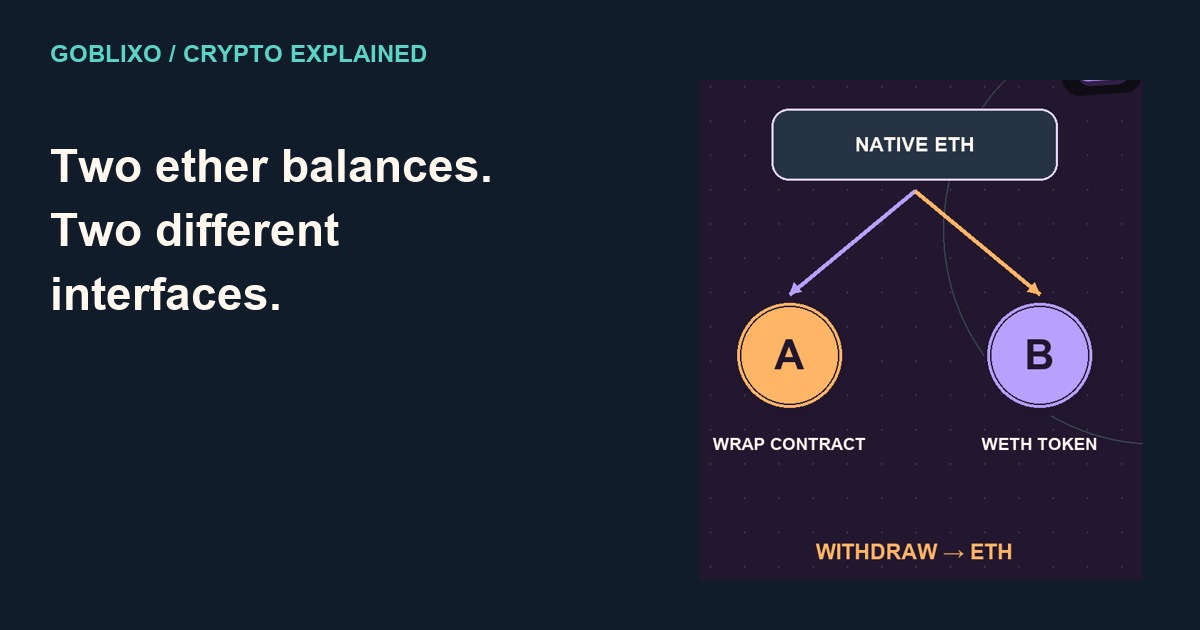
Native ether is Ethereum’s native asset and pays ordinary network gas. It existed before the ERC twenty token interface that many applications use to handle tokens consistently.
An erc-20 interface
Wrapped ether exposes an ERC twenty style interface. That lets applications interact with it using token methods and allowances. Similar economic exposure does not mean identical contract behavior.
Deposit and withdraw
In a conventional WETH contract, depositing ether creates the corresponding wrapped balance. Withdrawing reverses the process under the contract’s rules. The deposit and withdrawal are on chain actions.
Same chain is the point
This wrapping example stays on one network. A cross chain representation adds a different route and trust model. A token named WETH on another network needs its own contract and backing checks.
Check the contract
Ordinary Ethereum gas is paid in native ether, so a wrapped balance is not automatically the same fee balance. Some applications add sponsored flows, but those are specific features.
A careful way to use this explanation
Token symbols do not authenticate a contract. This article describes the conventional mechanism rather than validating any live token, bridge or application. Fees, supported interfaces and wrapping contracts vary by chain and implementation. Do not send native ether to an arbitrary address because a comment calls it a wrapping contract. Use the intended application’s official documentation and inspect what the transaction actually does.